(212) 220-6556
 Table of Contents
Altamirano PLLC is representing investors in Inspired Healthcare Capital (“IHC”), an Arizona-based alternative investment sponsor that has suspended all investment offerings and distributions during a regulatory review by the U.S. Securities and Exchange Commission (“SEC”) and a pending breach of contract lawsuit. The SEC initiated its investigation into IHC in 2025, which coincided with the suspension of distributions.
Inspired Healthcare Capital Files for Chapter 11 Bankruptcy
On February 2, 2026, Inspired Healthcare Capital announced it had filed for protection under Chapter 11 of the U.S. Bankruptcy Code. According to the company, the filing is part of a restructuring process aimed at addressing liquidity constraints, preserving operations at its senior-housing communities, and exploring strategic alternatives, including asset sales and balance-sheet restructuring. The filing follows years of reliance on new capital raises.
At the time of the Chapter 11 filing, Inspired Healthcare Capital reported between $1 billion and $10 billion in total liabilities. The scale of the filing underscores the financial complexity of the restructuring and the level of exposure faced by investors.
To support operations throughout the marketing and sale process, Inspired Healthcare Capital disclosed that it has secured $35 million in debtor-in-possession (“DIP”) financing.
A motion filed by the Debtors on February 6, 2026, in the Inspired Healthcare Capital bankruptcy outlines a plan to move IHC toward a structured asset sale under Chapter 11. According to the motion, the sale process is expected to extend well into mid-2026. The Debtors are seeking authority to designate one or more “stalking horse” bidders, which would establish a floor price for asset sales but also permit break-up fees of up to 3% and expense reimbursements of up to $2.5 million, paid directly from sale proceeds. These transaction costs reduce the funds ultimately available to creditors and investors.
The motion further provides that key details, including the identity of bidders, bid amounts, and proposed bid protections, will not be disclosed until later court filings, adding uncertainty to the process. The Debtors do not anticipate designating a stalking horse bidder until May 2026, with binding bids due in June and any auction scheduled for June 24, 2026. A sale hearing to approve any successful bid would not occur until the end of June, at the earliest.
The bankruptcy court has scheduled a hearing on the Debtors’ Motion for March 3, 2026, at 1:30 p.m. Central Time. The hearing will address multiple motions related to IHC’s financing and ongoing operations.
Together, these timelines highlight how slow and complex the Chapter 11 process is likely to be for Inspired Healthcare Capital investors.
The bankruptcy filing raises serious questions for investors regarding IHC’s offerings, including how these products were marketed, and whether the risks associated with the investments were fully disclosed by the broker-dealers and financial advisors who recommended them.
The bankruptcy court has also scheduled a meeting of creditors for March 16, 2026. The deadline for filing proofs of claim has not yet been established.
This page will be updated as more information becomes available.
On January 15, 2026, Inspired Healthcare Capital informed investors in its 1031 DST funds that IHC and its affiliates would not raise additional capital from investors and would not make any distributions until further notice.
IHC, which raised capital through Delaware Statutory Trusts (DSTs) and other private-placement investments tied to senior housing communities, has also shut down its in-house operating arm, Volante Senior Living, and transitioned management of those facilities to third-party operators. Notably, IHC sponsored specific DST projects such as Ashbrook DST IHC, Candle Light Cove DST, and Peachtree DST, and also managed funds like Capital Income Fund LLC, Security Income Fund LLC, and Healthcare Capital Fund LP. IHC’s sudden suspension of distributions has left many investors, particularly retirees, without anticipated income and facing uncertainty about the future of their investments. The suspension of income distributions from these funds and DSTs has been a major concern for affected investors.
Investors are now looking for information about Inspired Healthcare Capital’s halted DST distributions and the ongoing SEC review to understand what recovery options may be available.

Top Question Asked
What are common red flags of investment fraud?

Inspired Healthcare Capital: Background
Inspired Healthcare Capital built its business sponsoring and managing healthcare-focused real estate investments, particularly senior housing DSTs marketed to retail investors seeking stable, tax-advantaged income. These investments were often sold through independent broker-dealers and registered investment advisers as opportunities to participate in the senior living sector without the risks of direct property management.
In 2023, IHC launched Volante Senior Living, its own operating company designed to manage the growing portfolio of senior housing properties. By mid-2025, the firm reportedly oversaw more than 30 senior living communities across the country.
By the summer of 2025, warning signs began to emerge. According to a July 18, 2025, letter from CEO Luke Lee to investment advisors, IHC suspended all investment offerings and investor distributions while undergoing an SEC review and exploring “strategic alternatives.” The firm retained an investment bank to advise on restructuring or exit options and expected a review to conclude by mid-August. The complaint in the lawsuit alleges IHC was already insolvent by fall 2024 but misrepresented its financial stability to secure a $1.5 million loan in December 2024.
Soon after, Volante Senior Living ceased operations following the resignation, reportedly at IHC’s request, of its CEO Jeff Fischer. The properties formerly managed by Volante were transitioned to Leisure Care, a third-party operator. According to news reports, only 10 to 15 of IHC’s 35 senior living communities were performing well, underscoring the firm’s growing financial strain.
Additional Inspired Healthcare Capital Offerings
Inspired Healthcare Capital or IHC is a private equity firm specializing in senior housing and healthcare real estate investments, including independent living, assisted living, and memory care facilities. The company has attracted retail investors seeking stable, tax-advantaged exposure to the growing senior living sector through a variety of investment offerings, such as the Inspired Healthcare Capital Fund, Healthcare Capital Income Fund, and Healthcare Capital Liquidity Fund. These offerings were promoted as safe, income-producing opportunities, often emphasizing their potential for steady returns and tax efficiency.
IHC sponsored or served as manager for a series of Delaware Statutory Trusts (DSTs) named after the senior living communities or locations where they operated. It also sponsored or was manager in other private placement programs. SEC filings show that each of the following IHC offerings sought to raise significant capital from investors through Form D filings:
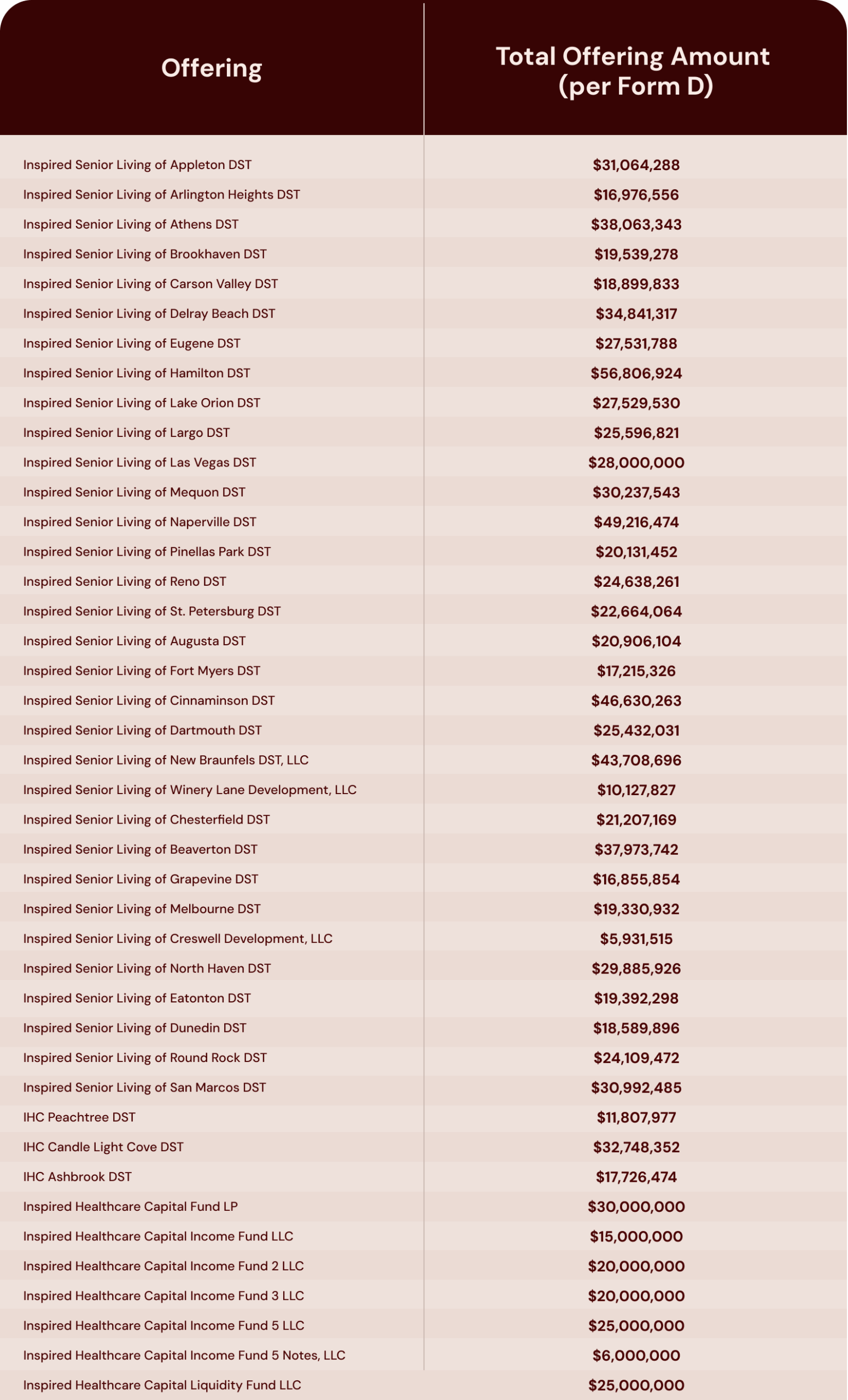
IHC’s offerings collectively sought to raise over $1.06 billion from investors, generating millions in commissions for the broker-dealers that sold the products. Amounts are based on Form D filings with the U.S. Securities and Exchange Commission. Actual capital raised may vary.
Investors in these offerings have been affected by the suspension of distributions and the broader regulatory review of IHC’s operations.
IHC DST Lawsuit Alleging Misrepresentation: SEC Review
The July 18 letter confirmed that IHC is under regulatory review by the SEC, though the company provided no details about the scope or focus of that inquiry. Less than two months later, IHC’s financial problems became public.
On September 5, 2025, Emerson Equity Bridge Fund I, LLC filed a $1.5 million breach of contract lawsuit against IHC and its CEO in California Superior Court. The complaint alleges that IHC defaulted on a loan made in December 2024 and misrepresented its financial condition, including failing to disclose more than $200 million in personal guarantees by its CEO. According to the suit, IHC ignored a repayment demand due September 1, 2025.
One week later, on September 12, 2025, IHC sent investors a letter stating: “We regret to inform you that no distributions will be made at this time.” The company offered no timeline for reinstating payments.
The combination of an SEC review, a breach of contract lawsuit, and a complete halt of investor distributions has fueled serious concerns about IHC’s financial stability.
What Has Been the Impact on IHC Investors?
The suspension of distributions has left investors, many of whom are retirees relying on steady income, without the payments they were promised. IHC’s DSTs and private placement offerings were marketed as stable, healthcare-backed real estate investments supported by aging demographics and long-term demand for senior living.
Now investors are discovering that their funds were exposed to leverage, illiquidity, and operational instability, while the sponsor itself faces mounting legal and regulatory pressure. The transition to third-party property management has further clouded the outlook for investors.
Our investment loss law firm is reviewing IHC DST recovery options and potential FINRA arbitration claims for affected investors. The firm is also investigating IHC’s broker-dealer network, including Emerson Equity LLC, which distributed many of the firm’s investment programs. The investigation focuses on whether brokers failed to conduct adequate due diligence, ignored red flags, or misrepresented the risks when recommending IHC’s products to retail clients.
The firm is speaking with investors to determine whether they were told IHC DSTs were safe, income-producing investments suitable for conservative portfolios when, in reality, they were illiquid, high-risk private securities.
What Are Delaware Statutory Trusts (DSTs)?
A Delaware Statutory Trust, or DST, is a legal structure that allows multiple investors to own fractional interests in real estate, often used in Section 1031 exchanges to defer capital gains taxes. DSTs are usually marketed as passive real estate ownership providing investors with steady income. Sponsors such as IHC acquire commercial properties, such as senior living facilities, and pool investor funds into the trust.
In return, investors receive proportional shares of income and potential appreciation. DSTs are securities typically offered under Regulation D exemptions, structured as private placements, and therefore not registered with the SEC.
DSTs are illiquid, meaning investors cannot easily sell their interests or access capital. Returns depend on the sponsor’s management decisions, operating performance, and financial condition. If the sponsor encounters financial or regulatory issues, as with IHC, investors may face suspended distributions and uncertainty over their investments.
Because of these risks, broker-dealers recommending DSTs must perform due diligence on both the sponsor and the underlying investment. They must also ensure the investment aligns with an investor’s financial profile and risk tolerance.
FINRA Rule 2111: Broker and Firm Obligations
Under FINRA Rule 2111, brokers must have a reasonable basis to believe that a recommended investment is suitable based on a client’s age, financial circumstances, and investment goals. Selling a complex, high-risk DST as a “safe” income product to retirees or conservative investors can violate that obligation.
Under Regulation Best Interest (Reg BI), brokers must go further, acting in the client’s best interest and considering the potential risks, rewards, and costs of each recommendation, including ongoing fees and future liquidation costs. They must also disclose any conflicts of interest, such as commissions or revenue-sharing agreements tied to product sales.
Although unregistered, IHC’s DSTs and private placement investments remain subject to federal and state securities law, including antifraud provisions. Brokers recommending them must comply with FINRA’s suitability and Regulation Best Interest standards.
When brokerage firms and financial advisors fail to meet these standards, investors may have claims for violations of Reg BI, unsuitable recommendations, failure to supervise, securities violations, and fraud or misrepresentation through FINRA arbitration.
FINRA Arbitration and Investor Claims Involving Inspired Healthcare Capital
Brokerage firms such as Emerson Equity LLC, which served as the managing broker-dealer for most of IHC’s DST and private placement offerings, are required to conduct independent due diligence on the sponsor and its operations before allowing their representatives to sell the products.
American Alternative Capital, LLC acted as the managing broker-dealer for the Inspired Senior Living of Augusta DST and Inspired Senior Living of Fort Myers DST offerings.
If Emerson Equity LLC or other firms failed to detect or disclose IHC’s financial instability, or if brokers downplayed risks to earn commissions, investors may have claims to pursue in FINRA arbitration.
Investors have filed arbitration claims against Emerson Equity LLC, Kingswood Capital Partners, and Great Point Capital seeking to recover losses tied to Inspired Healthcare Capital investments.
Common allegations may involve unsuitable investment recommendations, failures in due diligence or supervision, or inadequate disclosure of risks in connection with IHC-sponsored products.
Altamirano PLLC represents investors nationwide in cases against brokerage firms that sold unsuitable, high-risk alternative investments or misrepresented the risk and safety of the products.
According to its complaint against IHC, Emerson Equity Bridge Fund I, LLC does not share ownership interest in and is not affiliated in any way with Emerson Equity LLC.
Why This Matters: How to Recover Investment Losses
The IHC situation highlights the broader risks in the alternative investment industry and for investors seeking “safe” income. Products like DSTs and private placements are often sold as conservative, income-producing options but carry the same complexity and opacity that have plagued other failed investments such as GWG L Bonds, where investors have obtained significant recoveries through arbitration awards, and GPB Capital.
These investments generate high commissions for brokers but often leave investors with limited liquidity and expose them to a sponsor’s financial and operational stability. The SEC’s review of IHC and the pending lawsuit filed by Emerson Equity Bridge Fund I, LLC underscore the risks investors face when complex, illiquid products are sold as low-risk alternatives.
Investors in Inspired Healthcare Capital DSTs or other IHC offerings may be able to recover IHC losses through FINRA arbitration by filing a claim against the brokerage firm that recommended and sold the investments. Altamirano PLLC is reviewing claims related to unsuitable recommendations under FINRA Rule 2111, misrepresentation and omission of material facts, Reg BI violations for failure to disclose risks, failure to supervise, broker negligence and breach of fiduciary duty.
Investors who were told IHC’s products were safe, income-generating, or conservative are encouraged to contact Altamirano PLLC to discuss potential recovery options.

I heard about one of Jorge’s cases on the news and knew that if anyone could help me, it was him. He didn’t disappoint – he and his team went above and beyond to find a resolution to my case that I am very grateful for.
Contact Altamirano PLLC About Inspired Healthcare Capital Lawsuit Update
At Altamirano PLLC, we represent investors nationwide in securities arbitration involving misrepresentation, unsuitable recommendations, and alternative investment losses.
If you invested in Inspired Healthcare Capital DSTs or other IHC programs and have experienced suspended distributions or losses, call (212) 220-6556 to speak with our Principal, Jorge Altamirano, or email [email protected] to schedule a free consultation.
Jorge Altamirano has handled more than 1,500 investor cases, with total claims exceeding $200 million, recovering millions for clients across the country. His practice focuses solely on representing investors in disputes involving investment fraud, broker misconduct, unsuitable products, and supervisory failures, helping clients recover losses through FINRA arbitration.